
What Is Executive Financial Management, and Does Your Consulting Firm Need It?


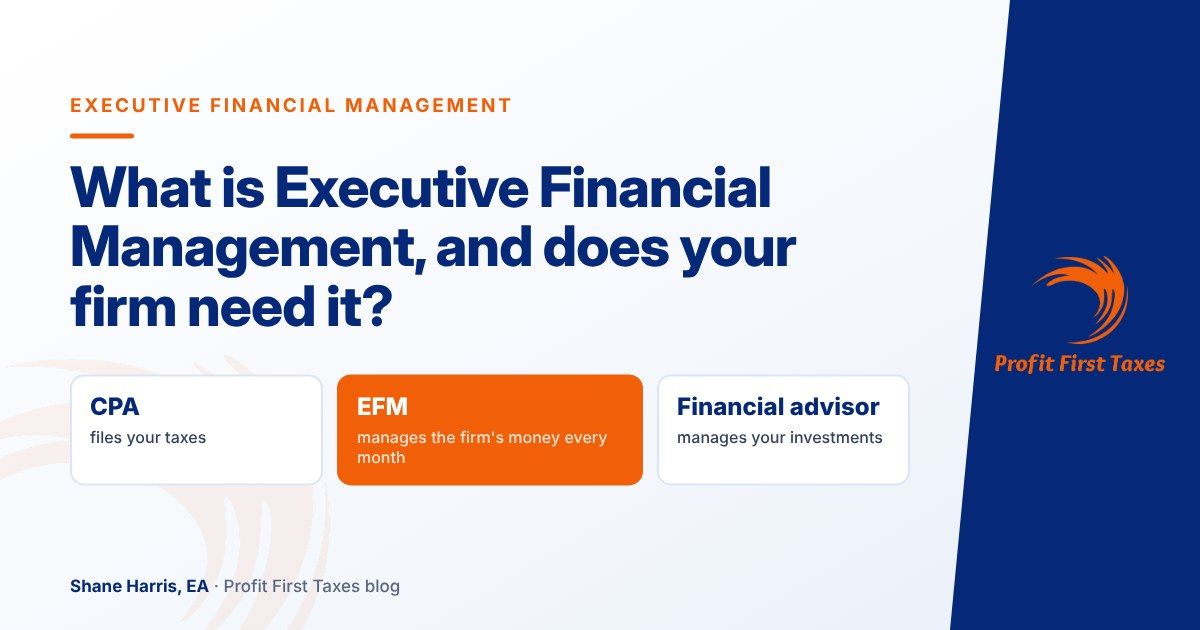
Most consultants who reach seven figures have two advisors: a CPA who files the taxes and a financial advisor who manages investments. Both matter. But neither one is managing the money inside the firm from month to month.
That gap is where margin quietly disappears. Executive Financial Management (EFM) is built to close it.
What Executive Financial Management is
Executive Financial Management is ongoing, CFO-level oversight of your firm's money. It is not bookkeeping, which records what already happened. It is not tax preparation, which reports it once a year. EFM uses those same numbers to decide what happens next.
In practice, that means someone reviews your accounts every month and helps you answer questions like these:
How much can I safely pay myself this month?
How much should be set aside for taxes right now?
Is my margin holding, or are costs creeping up?
Can the firm afford a senior hire, a partner or a new office?
What EFM covers
At Profit First Taxes, the EFM Program combines three or more financial management services into a 12-month engagement. Depending on the firm, that can include:
Cash flow and allocations. Every deposit gets a purpose: owner pay, profit, taxes and operating costs.
Owner pay planning. A planned amount the firm can sustain, not whatever is left over.
Tax reserves. Money set aside as you earn it, reviewed by an Enrolled Agent.
A monthly margin review. A line-by-line look for costs that drifted, work that never got billed and charges that shouldn't be there.
Growth decisions. Testing a hire or an investment against real cash flow before you commit.
How EFM is different from a fractional CFO
EFM is a form of fractional CFO service. The difference is focus. Many fractional CFOs work mainly on forecasting and investor reporting. EFM starts with the basics a consulting firm owner feels every month: cash, owner pay, taxes and margin. It is led by an Enrolled Agent, so the tax side is built in rather than handed off.
Signs your firm is ready for EFM
EFM tends to fit consulting and professional-service firms with roughly $500,000 or more in annual revenue. You may be ready if any of these sound familiar:
Revenue is strong, but cash still feels tight at the end of the month.
Your own pay changes from month to month based on the bank balance.
Estimated tax payments or year-end tax bills are a scramble.
You aren't sure what your profit margin was last quarter.
Subcontractor and software costs keep rising, and no one is reviewing them.
You want to grow but can't tell whether the firm can afford it.
How much time it takes
Most EFM clients spend about 1 to 2 hours a month on it. With the concierge option, we pull your statements and handle transfers between your accounts with your authorization. If you prefer to stay hands-on, you get clear instructions and make the transfers yourself.
Start with a free margin check
If you're not sure where your firm stands, start with our free guide, The Consultant's Margin Leak Review. It walks through five places high-earning firms lose profit, with a 15-minute check for each. To learn more about the program itself, see the Executive Financial Management page.
Talk it through
If your firm is making money but you're not keeping as much as you should, a short conversation will tell you whether EFM is the right fit.